Commander Synergies
Discover cards that synergize perfectly with your Commander.
Synergy
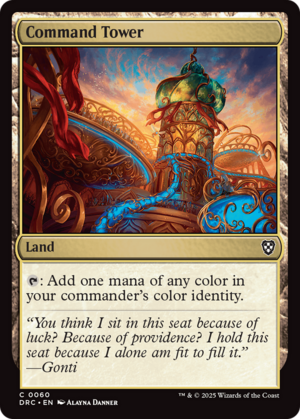
Card Details
Command Tower #60 Land
Info
| Color: |  |
| Identifies: | |
| Cost: | |
| Rarity: | Common |
| Converted Cost: | 0 |
| Power/Toughness: | / |
| Types: | |
| SubTypes: | |
| Languages: | 
         |
| Layout: | Normal |
| Rank: | |
| Saltiness: |
Rules
Text
 : Add one mana of any color in your commander's color identity.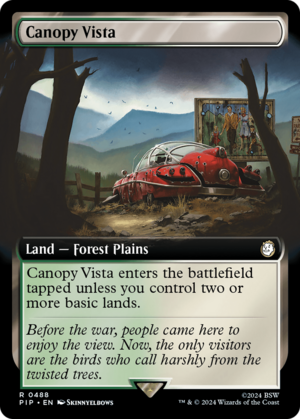
Card Details
Canopy Vista #488 Land — Forest Plains
Info
| Color: | |
| Identifies: |   |
| Cost: | |
| Rarity: | Rare |
| Converted Cost: | 0 |
| Power/Toughness: | / |
| Types: | |
| SubTypes: | |
| Languages: |
|
| Layout: | Normal |
| Rank: | |
| Saltiness: |
Rules
Prices
Legalities
Brawl
Paupercommander
Predh
Standardbrawl
Vintage
Gladiator
Premodern
Oathbreaker
Duel
Pauper
Modern
Alchemy
Future
Timeless
Historic
Oldschool
Penny
Commander
Legacy
Standard
Pioneer
Text
(: Add or .)
This land enters tapped unless you control two or more basic lands. 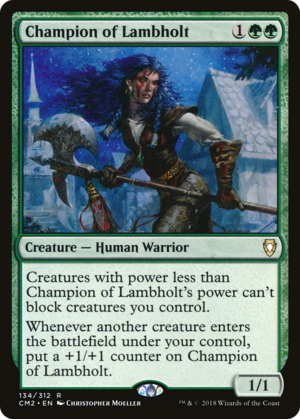
Card Details
Champion of Lambholt #134 Creature — Human Warrior
Info
| Color: | |
| Identifies: | |
| Cost: |
  |
| Rarity: | Rare |
| Converted Cost: | 3 |
| Power/Toughness: | 1/1 |
| Types: | |
| SubTypes: | |
| Languages: |
|
| Layout: | Normal |
| Rank: | |
| Saltiness: |
Rules
Text
Creatures with power less than this creature's power can't block creatures you control. Whenever another creature you control enters, put a +1/+1counteron this creature.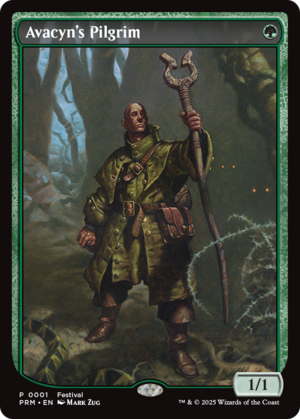
Card Details
Avacyn's Pilgrim #1F Creature — Human Monk
Info
| Color: | |
| Identifies: | |
| Cost: |
|
| Rarity: | Rare |
| Converted Cost: | 1 |
| Power/Toughness: | 1/1 |
| Types: | |
| SubTypes: | |
| Languages: |
|
| Layout: | Normal |
| Rank: | |
| Saltiness: |
Rules
Prices
Legalities
Brawl
Paupercommander
Predh
Standardbrawl
Vintage
Gladiator
Premodern
Oathbreaker
Duel
Pauper
Modern
Alchemy
Future
Timeless
Historic
Oldschool
Penny
Commander
Legacy
Standard
Pioneer
Text
: Add . 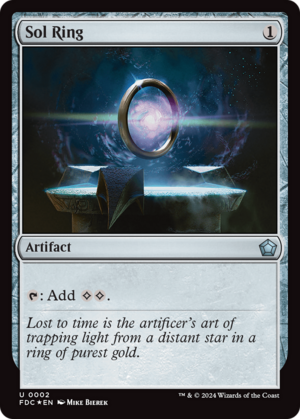
Card Details
Sol Ring #2 Artifact
Info
| Color: | |
| Identifies: | |
| Cost: |
|
| Rarity: | Uncommon |
| Converted Cost: | 1 |
| Power/Toughness: | / |
| Types: | |
| SubTypes: | |
| Languages: |
|
| Layout: | Normal |
| Rank: | |
| Saltiness: |
Rules
Text
: Add . 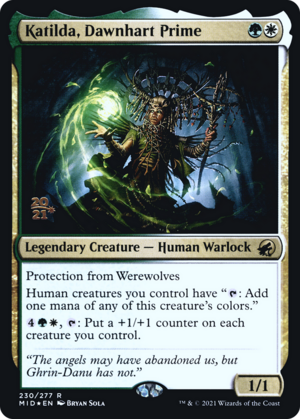
Card Details
Katilda, Dawnhart Prime #230s Legendary Creature — Human Warlock
Info
| Color: | |
| Identifies: | |
| Cost: |
 |
| Rarity: | Rare |
| Converted Cost: | 2 |
| Power/Toughness: | 1/1 |
| Types: | |
| SubTypes: | |
| Languages: |
|
| Layout: | Normal |
| Rank: | |
| Saltiness: |
Abilities/Keywords
Rules
Text
Protection from Werewolves Human creatures you control have ": Add one mana of any of this creature's colors."
 , : Put a +1/+1counteron each creature you control.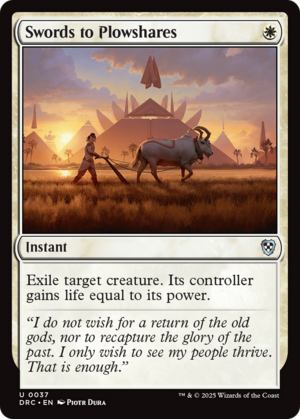
Card Details
Swords to Plowshares #37 Instant
Info
| Color: | |
| Identifies: | |
| Cost: |
|
| Rarity: | Uncommon |
| Converted Cost: | 1 |
| Power/Toughness: | / |
| Types: | |
| SubTypes: | |
| Languages: |
|
| Layout: | Normal |
| Rank: | |
| Saltiness: |
Rules
Text
Exile target creature. Its controller gains life equal to its power.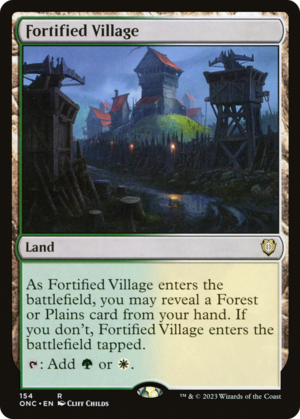
Card Details
Fortified Village #154 Land
Info
| Color: | |
| Identifies: | |
| Cost: | |
| Rarity: | Rare |
| Converted Cost: | 0 |
| Power/Toughness: | / |
| Types: | |
| SubTypes: | |
| Languages: |
|
| Layout: | Normal |
| Rank: | |
| Saltiness: |
Rules
Text
As this land enters, you may reveal a Forest or Plains card from your hand. If you don't, this land enters tapped.: Add or . 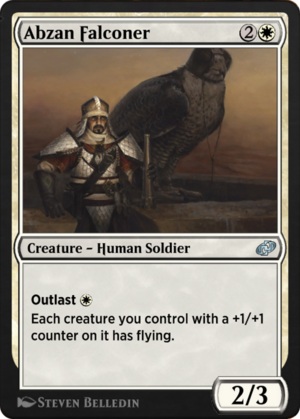
Card Details
Abzan Falconer #34 Creature — Human Soldier
Info
| Color: | |
| Identifies: | |
| Cost: |
 |
| Rarity: | Uncommon |
| Converted Cost: | 3 |
| Power/Toughness: | 2/3 |
| Types: | |
| SubTypes: | |
| Languages: |
|
| Layout: | Normal |
| Rank: | |
| Saltiness: |
Abilities/Keywords
Rules
Prices
| Seller | Price |
|---|
Legalities
Brawl
Paupercommander
Predh
Standardbrawl
Vintage
Gladiator
Premodern
Oathbreaker
Duel
Pauper
Modern
Alchemy
Future
Timeless
Historic
Oldschool
Penny
Commander
Legacy
Standard
Pioneer
Text
Outlast (, : Put a +1/+1counteron this creature. Outlast only as a sorcery.)
Each creature you control with a +1/+1counteron it has flying. 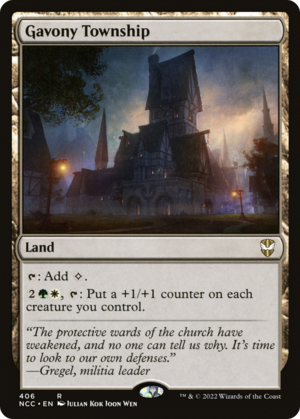
Card Details
Gavony Township #406 Land
Info
| Color: | |
| Identifies: | |
| Cost: | |
| Rarity: | Rare |
| Converted Cost: | 0 |
| Power/Toughness: | / |
| Types: | |
| SubTypes: | |
| Languages: |
|
| Layout: | Normal |
| Rank: | |
| Saltiness: |
Rules
Text
: Add .
 , : Put a +1/+1counteron each creature you control.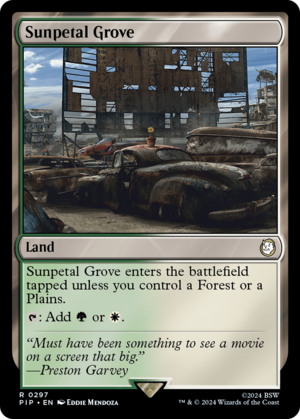
Card Details
Sunpetal Grove #297 Land
Info
| Color: | |
| Identifies: | |
| Cost: | |
| Rarity: | Rare |
| Converted Cost: | 0 |
| Power/Toughness: | / |
| Types: | |
| SubTypes: | |
| Languages: |
|
| Layout: | Normal |
| Rank: | |
| Saltiness: |
Rules
Prices
Legalities
Brawl
Paupercommander
Predh
Standardbrawl
Vintage
Gladiator
Premodern
Oathbreaker
Duel
Pauper
Modern
Alchemy
Future
Timeless
Historic
Oldschool
Penny
Commander
Legacy
Standard
Pioneer
Text
This land enters tapped unless you control a Forest or a Plains.: Add or . 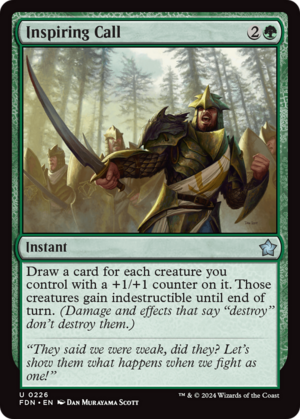
Card Details
Inspiring Call #226 Instant
Info
| Color: | |
| Identifies: | |
| Cost: |
|
| Rarity: | Uncommon |
| Converted Cost: | 3 |
| Power/Toughness: | / |
| Types: | |
| SubTypes: | |
| Languages: |
|
| Layout: | Normal |
| Rank: | |
| Saltiness: |
Rules
Prices
Legalities
Brawl
Paupercommander
Predh
Standardbrawl
Vintage
Gladiator
Premodern
Oathbreaker
Duel
Pauper
Modern
Alchemy
Future
Timeless
Historic
Oldschool
Penny
Commander
Legacy
Standard
Pioneer
Text
Draw a card for each creature you control with a +1/+1counteron it. Those creatures gain indestructible until end of turn. (Damage and effects that say "destroy" don'tdestroythem.)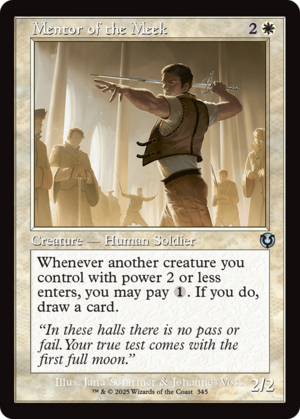
Card Details
Mentor of the Meek #345 Creature — Human Soldier
Info
| Color: | |
| Identifies: | |
| Cost: |
|
| Rarity: | Uncommon |
| Converted Cost: | 3 |
| Power/Toughness: | 2/2 |
| Types: | |
| SubTypes: | |
| Languages: |
|
| Layout: | Normal |
| Rank: | |
| Saltiness: |
Rules
Prices
Legalities
Brawl
Paupercommander
Predh
Standardbrawl
Vintage
Gladiator
Premodern
Oathbreaker
Duel
Pauper
Modern
Alchemy
Future
Timeless
Historic
Oldschool
Penny
Commander
Legacy
Standard
Pioneer
Text
Whenever another creature you control with power 2 or less enters, you may pay . If you do, draw a card.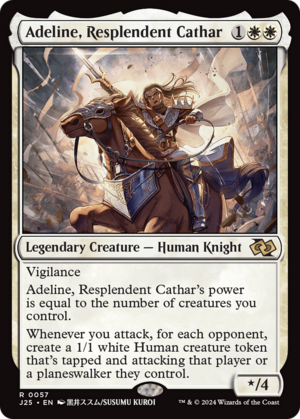
Card Details
Adeline, Resplendent Cathar #57 Legendary Creature — Human Knight
Info
| Color: | |
| Identifies: | |
| Cost: |
|
| Rarity: | Rare |
| Converted Cost: | 3 |
| Power/Toughness: | */4 |
| Types: | |
| SubTypes: | |
| Languages: |
|
| Layout: | Normal |
| Rank: | |
| Saltiness: | |
| Tokens: |
Abilities/Keywords
Rules
Text
Vigilance Adeline's power is equal to the number of creatures you control. Whenever you attack, for each opponent, create a 1/1 white Human creature token that's tapped and attacking that player or a planeswalker they control.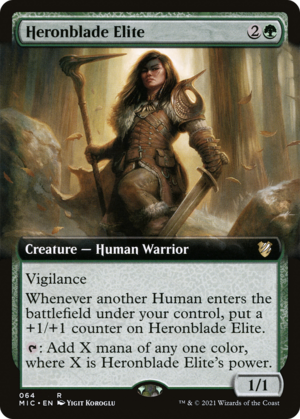
Card Details
Heronblade Elite #64 Creature — Human Warrior
Info
| Color: | |
| Identifies: | |
| Cost: |
|
| Rarity: | Rare |
| Converted Cost: | 3 |
| Power/Toughness: | 1/1 |
| Types: | |
| SubTypes: | |
| Languages: |
|
| Layout: | Normal |
| Rank: | |
| Saltiness: |
Abilities/Keywords
Rules
Text
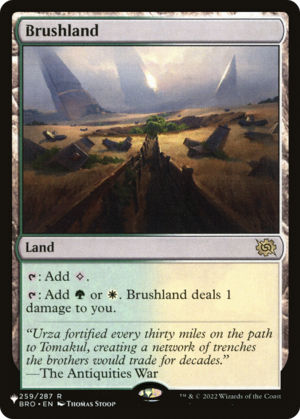
Vigilance Whenever another Human you control enters, put a +1/+1counteron this creature.: Add X mana of any one color, where X is this creature's power. Less Synergy
Card Details
Brushland #BRO-259 Land
Info
| Color: | |
| Identifies: | |
| Cost: | |
| Rarity: | Rare |
| Converted Cost: | 0 |
| Power/Toughness: | / |
| Types: | |
| SubTypes: | |
| Languages: |
|
| Layout: | Normal |
| Rank: | |
| Saltiness: |
Rules
Text
: Add .
: Add or . This land deals 1 damage to you. 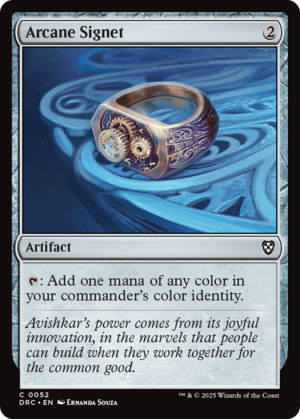
Card Details
Arcane Signet #52 Artifact
Info
| Color: | |
| Identifies: | |
| Cost: |
|
| Rarity: | Common |
| Converted Cost: | 2 |
| Power/Toughness: | / |
| Types: | |
| SubTypes: | |
| Languages: |
|
| Layout: | Normal |
| Rank: | |
| Saltiness: |
Rules
Text
: Add one mana of any color in your commander's color identity. 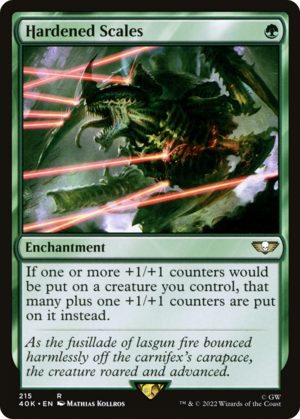
Card Details
Hardened Scales #215 Enchantment
Info
| Color: | |
| Identifies: | |
| Cost: |
|
| Rarity: | Rare |
| Converted Cost: | 1 |
| Power/Toughness: | / |
| Types: | |
| SubTypes: | |
| Languages: |
|
| Layout: | Normal |
| Rank: | |
| Saltiness: |
Rules
Prices
Legalities
Brawl
Paupercommander
Predh
Standardbrawl
Vintage
Gladiator
Premodern
Oathbreaker
Duel
Pauper
Modern
Alchemy
Future
Timeless
Historic
Oldschool
Penny
Commander
Legacy
Standard
Pioneer
Text
If one or more +1/+1 counters would be put on a creature you control, that many plus one +1/+1 counters are put on it instead.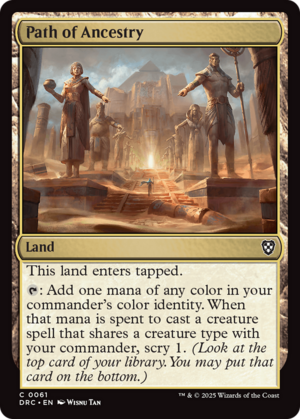
Card Details
Path of Ancestry #61 Land
Info
| Color: | |
| Identifies: | |
| Cost: | |
| Rarity: | Common |
| Converted Cost: | 0 |
| Power/Toughness: | / |
| Types: | |
| SubTypes: | |
| Languages: |
|
| Layout: | Normal |
| Rank: | |
| Saltiness: |
Abilities/Keywords
Rules
Text
This land enters tapped.: Add one mana of any color in your commander's color identity. When that mana is spent to cast a creature spell that shares a creature type with your commander, scry 1. (Look at the top card of your library. You may put that card on the bottom.) 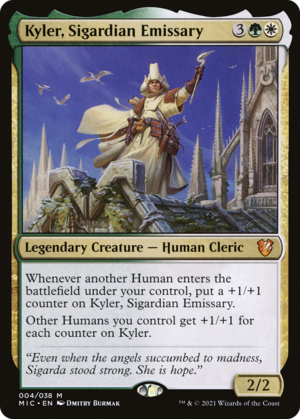
Card Details
Kyler, Sigardian Emissary #4 Legendary Creature — Human Cleric
Info
| Color: | |
| Identifies: | |
| Cost: |
 |
| Rarity: | Mythic |
| Converted Cost: | 5 |
| Power/Toughness: | 2/2 |
| Types: | |
| SubTypes: | |
| Languages: |
|
| Layout: | Normal |
| Rank: | |
| Saltiness: |
Rules
Prices
Legalities
Brawl
Paupercommander
Predh
Standardbrawl
Vintage
Gladiator
Premodern
Oathbreaker
Duel
Pauper
Modern
Alchemy
Future
Timeless
Historic
Oldschool
Penny
Commander
Legacy
Standard
Pioneer
Text
Whenever another Human you control enters, put a +1/+1counteron Kyler. Other Humans you control get +1/+1 for eachcounteron Kyler.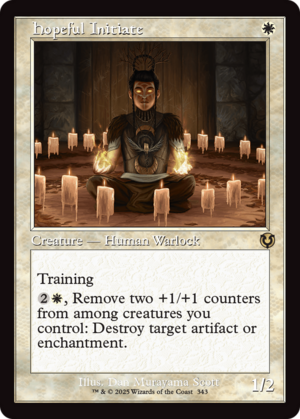
Card Details
Hopeful Initiate #343 Creature — Human Warlock
Info
| Color: | |
| Identifies: | |
| Cost: |
|
| Rarity: | Rare |
| Converted Cost: | 1 |
| Power/Toughness: | 1/2 |
| Types: | |
| SubTypes: | |
| Languages: |
|
| Layout: | Normal |
| Rank: | |
| Saltiness: |
Abilities/Keywords
Rules
Prices
Legalities
Brawl
Paupercommander
Predh
Standardbrawl
Vintage
Gladiator
Premodern
Oathbreaker
Duel
Pauper
Modern
Alchemy
Future
Timeless
Historic
Oldschool
Penny
Commander
Legacy
Standard
Pioneer
Text
Training (Whenever this creature attacks with another creature with greater power, put a +1/+1counteron this creature.), Remove two +1/+1 counters from among creatures you control:Destroytarget artifact or enchantment. 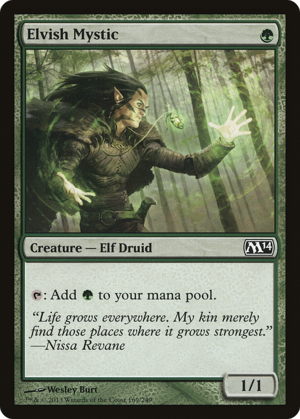
Card Details
Elvish Mystic #169 aka. Fishstick Creature — Elf Druid
Info
| Color: | |
| Identifies: | |
| Cost: |
|
| Rarity: | Common |
| Converted Cost: | 1 |
| Power/Toughness: | 1/1 |
| Types: | |
| SubTypes: | |
| Languages: |
|
| Layout: | Normal |
| Rank: | |
| Saltiness: |
Rules
Prices
Legalities
Brawl
Paupercommander
Predh
Standardbrawl
Vintage
Gladiator
Premodern
Oathbreaker
Duel
Pauper
Modern
Alchemy
Future
Timeless
Historic
Oldschool
Penny
Commander
Legacy
Standard
Pioneer
Text
: Add . 
Card Details
Temple Garden #281 Land — Forest Plains
Info
| Color: | |
| Identifies: | |
| Cost: | |
| Rarity: | Rare |
| Converted Cost: | 0 |
| Power/Toughness: | / |
| Types: | |
| SubTypes: | |
| Languages: |
|
| Layout: | Normal |
| Rank: | |
| Saltiness: |
Rules
Prices
Legalities
Brawl
Paupercommander
Predh
Standardbrawl
Vintage
Gladiator
Premodern
Oathbreaker
Duel
Pauper
Modern
Alchemy
Future
Timeless
Historic
Oldschool
Penny
Commander
Legacy
Standard
Pioneer
Text
(: Add or .)
As this land enters, you may pay 2 life. If you don't, it enters tapped. 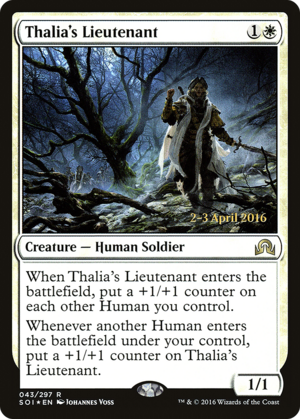
Card Details
Thalia's Lieutenant #43s Creature — Human Soldier
Info
| Color: | |
| Identifies: | |
| Cost: |
|
| Rarity: | Rare |
| Converted Cost: | 2 |
| Power/Toughness: | 1/1 |
| Types: | |
| SubTypes: | |
| Languages: |
|
| Layout: | Normal |
| Rank: | |
| Saltiness: |
Rules
Text
When this creature enters, put a +1/+1counteron each other Human you control. Whenever another Human you control enters, put a +1/+1counteron this creature.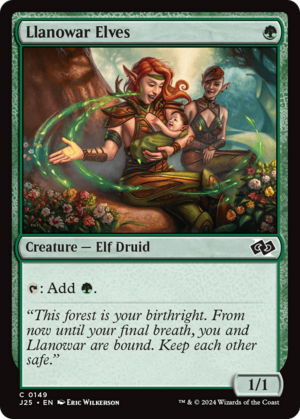
Card Details
Llanowar Elves #149 Creature — Elf Druid
Info
| Color: | |
| Identifies: | |
| Cost: |
|
| Rarity: | Common |
| Converted Cost: | 1 |
| Power/Toughness: | 1/1 |
| Types: | |
| SubTypes: | |
| Languages: |
|
| Layout: | Normal |
| Rank: | |
| Saltiness: |
Rules
Text
: Add . 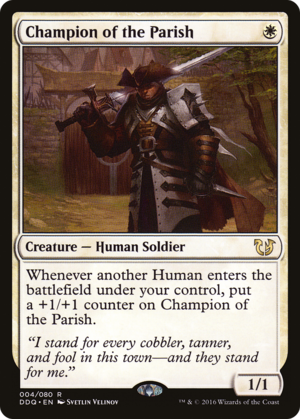
Card Details
Champion of the Parish #4 Creature — Human Soldier
Info
| Color: | |
| Identifies: | |
| Cost: |
|
| Rarity: | Rare |
| Converted Cost: | 1 |
| Power/Toughness: | 1/1 |
| Types: | |
| SubTypes: | |
| Languages: |
|
| Layout: | Normal |
| Rank: | |
| Saltiness: |
Rules
Text
Whenever another Human you control enters, put a +1/+1counteron this creature.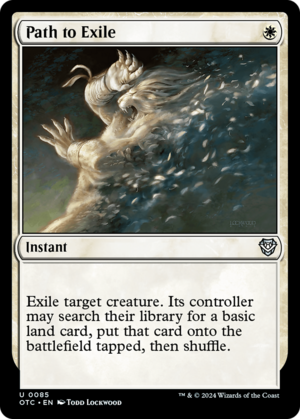
Card Details
Path to Exile #85 aka. Path Instant
Info
| Color: | |
| Identifies: | |
| Cost: |
|
| Rarity: | Uncommon |
| Converted Cost: | 1 |
| Power/Toughness: | / |
| Types: | |
| SubTypes: | |
| Languages: |
|
| Layout: | Normal |
| Rank: | |
| Saltiness: |
Rules
Text
Exile target creature. Its controller may search their library for a basic land card, put that card onto the battlefield tapped, thenshuffle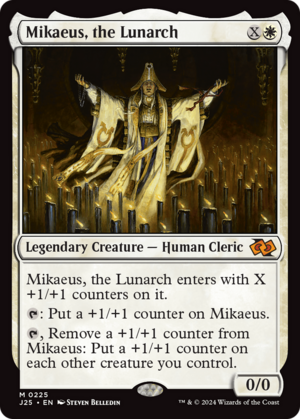
Card Details
Mikaeus, the Lunarch #225 Legendary Creature — Human Cleric
Info
| Color: | |
| Identifies: | |
| Cost: |
 |
| Rarity: | Mythic |
| Converted Cost: | 1 |
| Power/Toughness: | 0/0 |
| Types: | |
| SubTypes: | |
| Languages: |
|
| Layout: | Normal |
| Rank: | |
| Saltiness: |
Rules
Text
Mikaeus enters with X +1/+1 counters on it.: Put a +1/+1counteron Mikaeus.
, Remove a +1/+1counterfrom Mikaeus: Put a +1/+1counteron each other creature you control. 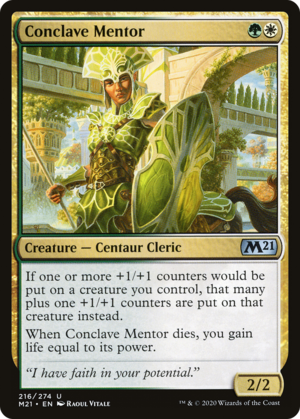
Card Details
Conclave Mentor #216 Creature — Centaur Cleric
Info
| Color: | |
| Identifies: | |
| Cost: |
|
| Rarity: | Uncommon |
| Converted Cost: | 2 |
| Power/Toughness: | 2/2 |
| Types: | |
| SubTypes: | |
| Languages: |
|
| Layout: | Normal |
| Rank: | |
| Saltiness: |
Rules
Prices
Legalities
Brawl
Paupercommander
Predh
Standardbrawl
Vintage
Gladiator
Premodern
Oathbreaker
Duel
Pauper
Modern
Alchemy
Future
Timeless
Historic
Oldschool
Penny
Commander
Legacy
Standard
Pioneer
Text
If one or more +1/+1 counters would be put on a creature you control, that many plus one +1/+1 counters are put on that creature instead. When this creature dies, you gain life equal to its power.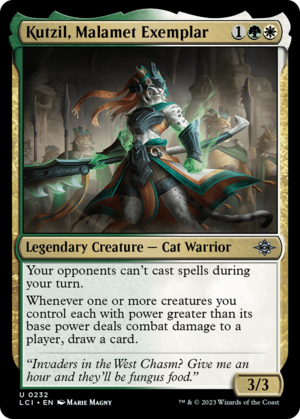
Card Details
Kutzil, Malamet Exemplar #232 Legendary Creature — Cat Warrior
Info
| Color: | |
| Identifies: | |
| Cost: |
|
| Rarity: | Uncommon |
| Converted Cost: | 3 |
| Power/Toughness: | 3/3 |
| Types: | |
| SubTypes: | |
| Languages: |
|
| Layout: | Normal |
| Rank: | |
| Saltiness: |
Rules
Prices
Legalities
Brawl
Paupercommander
Predh
Standardbrawl
Vintage
Gladiator
Premodern
Oathbreaker
Duel
Pauper
Modern
Alchemy
Future
Timeless
Historic
Oldschool
Penny
Commander
Legacy
Standard
Pioneer
Text
Your opponents can't cast spells during your turn. Whenever one or more creatures you control each with power greater than its base power deals combat damage to a player, draw a card.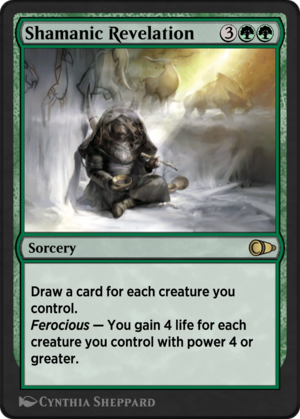
Card Details
Shamanic Revelation #194 Sorcery
Info
| Color: | |
| Identifies: | |
| Cost: |
|
| Rarity: | Rare |
| Converted Cost: | 5 |
| Power/Toughness: | / |
| Types: | |
| SubTypes: | |
| Languages: |
|
| Layout: | Normal |
| Rank: | |
| Saltiness: |
Abilities/Keywords
Rules
Prices
| Seller | Price |
|---|
Legalities
Brawl
Paupercommander
Predh
Standardbrawl
Vintage
Gladiator
Premodern
Oathbreaker
Duel
Pauper
Modern
Alchemy
Future
Timeless
Historic
Oldschool
Penny
Commander
Legacy
Standard
Pioneer
Text
Draw a card for each creature you control. Ferocious — You gain 4 life for each creature you control with power 4 or greater.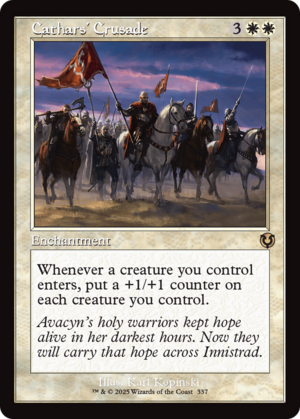
Card Details
Cathars' Crusade #337 Enchantment
Info
| Color: | |
| Identifies: | |
| Cost: |
|
| Rarity: | Rare |
| Converted Cost: | 5 |
| Power/Toughness: | / |
| Types: | |
| SubTypes: | |
| Languages: |
|
| Layout: | Normal |
| Rank: | |
| Saltiness: |
Rules
Prices
Legalities
Brawl
Paupercommander
Predh
Standardbrawl
Vintage
Gladiator
Premodern
Oathbreaker
Duel
Pauper
Modern
Alchemy
Future
Timeless
Historic
Oldschool
Penny
Commander
Legacy
Standard
Pioneer
Text
Whenever a creature you control enters, put a +1/+1counteron each creature you control.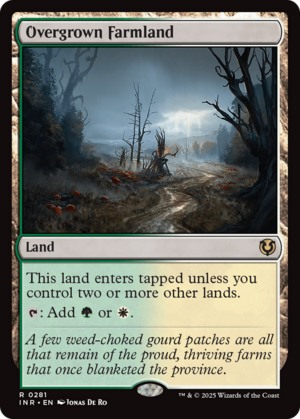
Card Details
Overgrown Farmland #281 Land
Info
| Color: | |
| Identifies: | |
| Cost: | |
| Rarity: | Rare |
| Converted Cost: | 0 |
| Power/Toughness: | / |
| Types: | |
| SubTypes: | |
| Languages: |
|
| Layout: | Normal |
| Rank: | |
| Saltiness: |
Rules
Prices
Legalities
Brawl
Paupercommander
Predh
Standardbrawl
Vintage
Gladiator
Premodern
Oathbreaker
Duel
Pauper
Modern
Alchemy
Future
Timeless
Historic
Oldschool
Penny
Commander
Legacy
Standard
Pioneer
Text
This land enters tapped unless you control two or more other lands.: Add or . 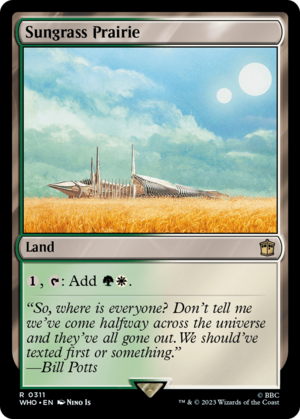
Card Details
Sungrass Prairie #311 Land
Info
| Color: | |
| Identifies: | |
| Cost: | |
| Rarity: | Rare |
| Converted Cost: | 0 |
| Power/Toughness: | / |
| Types: | |
| SubTypes: | |
| Languages: |
|
| Layout: | Normal |
| Rank: | |
| Saltiness: |
Rules
Prices
Legalities
Brawl
Paupercommander
Predh
Standardbrawl
Vintage
Gladiator
Premodern
Oathbreaker
Duel
Pauper
Modern
Alchemy
Future
Timeless
Historic
Oldschool
Penny
Commander
Legacy
Standard
Pioneer
Text
, : Add . 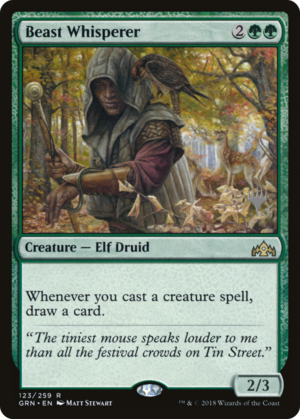
Card Details
Beast Whisperer #123p Creature — Elf Druid
Info
| Color: | |
| Identifies: | |
| Cost: |
|
| Rarity: | Rare |
| Converted Cost: | 4 |
| Power/Toughness: | 2/3 |
| Types: | |
| SubTypes: | |
| Languages: |
|
| Layout: | Normal |
| Rank: | |
| Saltiness: |
Rules
Prices
Legalities
Brawl
Paupercommander
Predh
Standardbrawl
Vintage
Gladiator
Premodern
Oathbreaker
Duel
Pauper
Modern
Alchemy
Future
Timeless
Historic
Oldschool
Penny
Commander
Legacy
Standard
Pioneer
Text
Whenever you cast a creature spell, draw a card.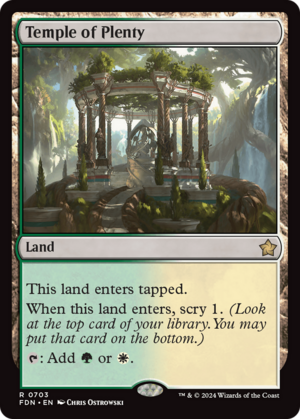
Card Details
Temple of Plenty #703 Land
Info
| Color: | |
| Identifies: | |
| Cost: | |
| Rarity: | Rare |
| Converted Cost: | 0 |
| Power/Toughness: | / |
| Types: | |
| SubTypes: | |
| Languages: |
|
| Layout: | Normal |
| Rank: | |
| Saltiness: |
Abilities/Keywords
Rules
Text
This land enters tapped. When this land enters, scry 1. (Look at the top card of your library. You may put that card on the bottom.): Add or . 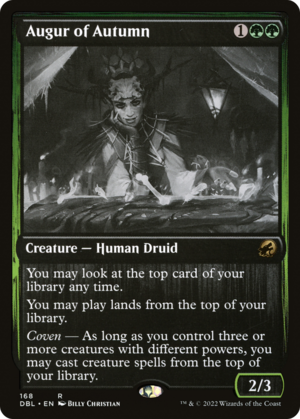
Card Details
Augur of Autumn #168 Creature — Human Druid
Info
| Color: | |
| Identifies: | |
| Cost: |
|
| Rarity: | Rare |
| Converted Cost: | 3 |
| Power/Toughness: | 2/3 |
| Types: | |
| SubTypes: | |
| Languages: |
|
| Layout: | Normal |
| Rank: | |
| Saltiness: |
Abilities/Keywords
Rules
Prices
Legalities
Brawl
Paupercommander
Predh
Standardbrawl
Vintage
Gladiator
Premodern
Oathbreaker
Duel
Pauper
Modern
Alchemy
Future
Timeless
Historic
Oldschool
Penny
Commander
Legacy
Standard
Pioneer
Text
You may look at the top card of your library any time. You may play lands from the top of your library. Coven — As long as you control three or more creatures with different powers, you may cast creature spells from the top of your library.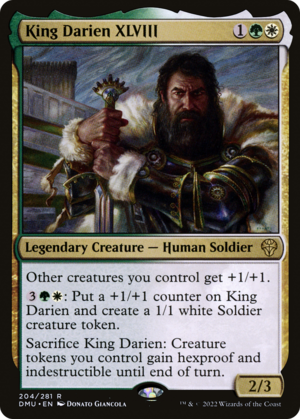
Card Details
King Darien XLVIII #204 Legendary Creature — Human Soldier
Info
| Color: | |
| Identifies: | |
| Cost: |
|
| Rarity: | Rare |
| Converted Cost: | 3 |
| Power/Toughness: | 2/3 |
| Types: | |
| SubTypes: | |
| Languages: |
|
| Layout: | Normal |
| Rank: | |
| Saltiness: | |
| Tokens: |
Rules
Prices
Legalities
Brawl
Paupercommander
Predh
Standardbrawl
Vintage
Gladiator
Premodern
Oathbreaker
Duel
Pauper
Modern
Alchemy
Future
Timeless
Historic
Oldschool
Penny
Commander
Legacy
Standard
Pioneer
Text
Other creatures you control get +1/+1. : Put a +1/+1counteron King Darien and create a 1/1 white Soldier creature token.
Sacrifice King Darien: Creature tokens you control gain hexproof and indestructible until end of turn.
: Put a +1/+1counteron King Darien and create a 1/1 white Soldier creature token.
Sacrifice King Darien: Creature tokens you control gain hexproof and indestructible until end of turn. 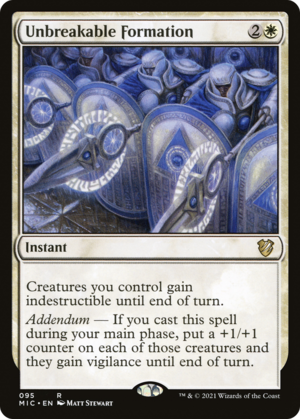
Card Details
Unbreakable Formation #95 Instant
Info
| Color: | |
| Identifies: | |
| Cost: |
|
| Rarity: | Rare |
| Converted Cost: | 3 |
| Power/Toughness: | / |
| Types: | |
| SubTypes: | |
| Languages: |
|
| Layout: | Normal |
| Rank: | |
| Saltiness: |
Abilities/Keywords
Rules
Text
Creatures you control gain indestructible until end of turn. Addendum — If you cast this spell during your main phase, put a +1/+1counteron each of those creatures and they gain vigilance until end of turn.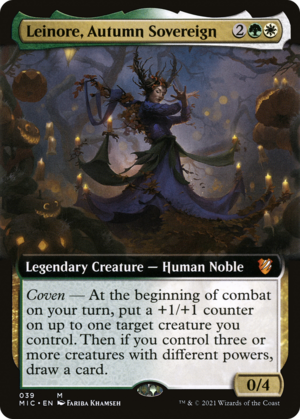
Card Details
Leinore, Autumn Sovereign #39 Legendary Creature — Human Noble
Info
| Color: | |
| Identifies: | |
| Cost: |
|
| Rarity: | Mythic |
| Converted Cost: | 4 |
| Power/Toughness: | 0/4 |
| Types: | |
| SubTypes: | |
| Languages: |
|
| Layout: | Normal |
| Rank: | |
| Saltiness: |
Abilities/Keywords
Rules
Text
Coven — At the beginning of combat on your turn, put a +1/+1counteron up to one target creature you control. Then if you control three or more creatures with different powers, draw a card.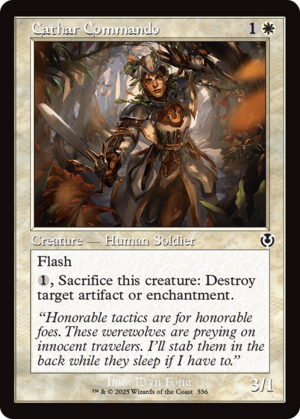
Card Details
Cathar Commando #336 Creature — Human Soldier
Info
| Color: | |
| Identifies: | |
| Cost: |
|
| Rarity: | Common |
| Converted Cost: | 2 |
| Power/Toughness: | 3/1 |
| Types: | |
| SubTypes: | |
| Languages: |
|
| Layout: | Normal |
| Rank: | |
| Saltiness: |
Abilities/Keywords
Rules
Prices
Legalities
Brawl
Paupercommander
Predh
Standardbrawl
Vintage
Gladiator
Premodern
Oathbreaker
Duel
Pauper
Modern
Alchemy
Future
Timeless
Historic
Oldschool
Penny
Commander
Legacy
Standard
Pioneer
Text
Flash,Sacrificethis creature:Destroytarget artifact or enchantment. 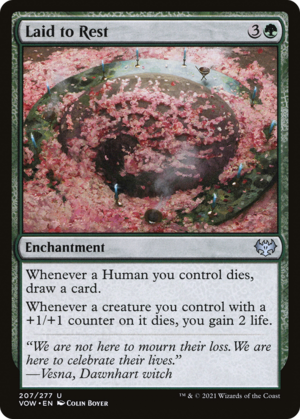
Card Details
Laid to Rest #207 Enchantment
Info
| Color: | |
| Identifies: | |
| Cost: |
|
| Rarity: | Uncommon |
| Converted Cost: | 4 |
| Power/Toughness: | / |
| Types: | |
| SubTypes: | |
| Languages: |
|
| Layout: | Normal |
| Rank: | |
| Saltiness: |
Rules
Prices
Legalities
Brawl
Paupercommander
Predh
Standardbrawl
Vintage
Gladiator
Premodern
Oathbreaker
Duel
Pauper
Modern
Alchemy
Future
Timeless
Historic
Oldschool
Penny
Commander
Legacy
Standard
Pioneer
Text
Whenever a Human you control dies, draw a card. Whenever a creature you control with a +1/+1counteron it dies, you gain 2 life.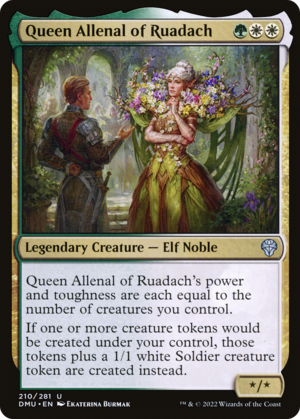
Card Details
Queen Allenal of Ruadach #210 Legendary Creature — Elf Noble
Info
| Color: | |
| Identifies: | |
| Cost: |
|
| Rarity: | Uncommon |
| Converted Cost: | 3 |
| Power/Toughness: | */* |
| Types: | |
| SubTypes: | |
| Languages: |
|
| Layout: | Normal |
| Rank: | |
| Saltiness: | |
| Tokens: |
Rules
Prices
Legalities
Brawl
Paupercommander
Predh
Standardbrawl
Vintage
Gladiator
Premodern
Oathbreaker
Duel
Pauper
Modern
Alchemy
Future
Timeless
Historic
Oldschool
Penny
Commander
Legacy
Standard
Pioneer
Text
Queen Allenal of Ruadach's power and toughness are each equal to the number of creatures you control. If one or more creature tokens would be created under your control, those tokens plus a 1/1 white Soldier creature token are created instead.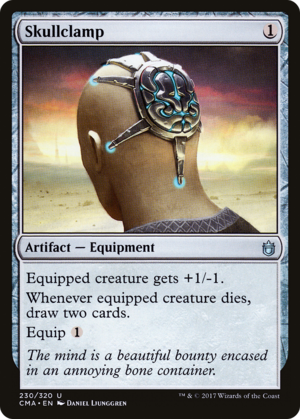
Card Details
Skullclamp #230 Artifact — Equipment
Info
| Color: | |
| Identifies: | |
| Cost: |
|
| Rarity: | Uncommon |
| Converted Cost: | 1 |
| Power/Toughness: | / |
| Types: | |
| SubTypes: | |
| Languages: |
|
| Layout: | Normal |
| Rank: | |
| Saltiness: |
Abilities/Keywords
Rules
Text
Equipped creature gets +1/-1. Whenever equipped creature dies, draw two cards. Equip 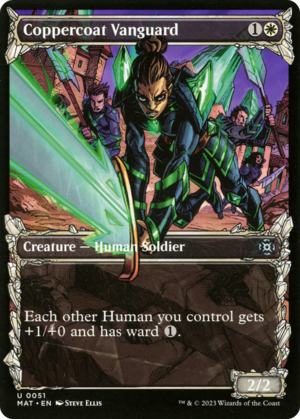
Card Details
Coppercoat Vanguard #51 Creature — Human Soldier
Info
| Color: | |
| Identifies: | |
| Cost: |
|
| Rarity: | Uncommon |
| Converted Cost: | 2 |
| Power/Toughness: | 2/2 |
| Types: | |
| SubTypes: | |
| Languages: |
|
| Layout: | Normal |
| Rank: | |
| Saltiness: |
Rules
Prices
Legalities
Brawl
Paupercommander
Predh
Standardbrawl
Vintage
Gladiator
Premodern
Oathbreaker
Duel
Pauper
Modern
Alchemy
Future
Timeless
Historic
Oldschool
Penny
Commander
Legacy
Standard
Pioneer
Text
Each other Human you control gets +1/+0 and has ward. (Whenever it becomes the target of a spell or ability an opponent controls,counterit unless that player pays .) 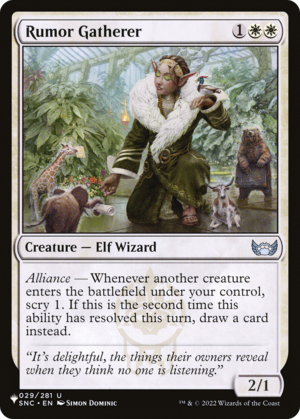
Card Details
Rumor Gatherer #SNC-29 Creature — Elf Wizard
Info
| Color: | |
| Identifies: | |
| Cost: |
|
| Rarity: | Uncommon |
| Converted Cost: | 3 |
| Power/Toughness: | 2/1 |
| Types: | |
| SubTypes: | |
| Languages: |
|
| Layout: | Normal |
| Rank: | |
| Saltiness: |
Abilities/Keywords
Rules
Text
Alliance — Whenever another creature you control enters, scry 1. If this is the second time this ability has resolved this turn, draw a card instead.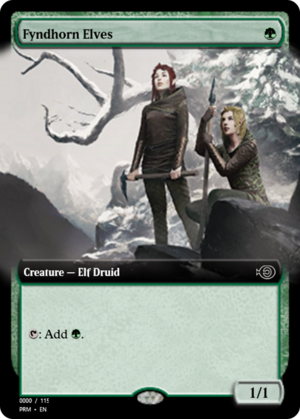
Card Details
Fyndhorn Elves #86118 Creature — Elf Druid
Info
| Color: | |
| Identifies: | |
| Cost: |
|
| Rarity: | Common |
| Converted Cost: | 1 |
| Power/Toughness: | 1/1 |
| Types: | |
| SubTypes: | |
| Languages: |
|
| Layout: | Normal |
| Rank: | |
| Saltiness: |
Rules
Prices
| Seller | Price |
|---|
Legalities
Brawl
Paupercommander
Predh
Standardbrawl
Vintage
Gladiator
Premodern
Oathbreaker
Duel
Pauper
Modern
Alchemy
Future
Timeless
Historic
Oldschool
Penny
Commander
Legacy
Standard
Pioneer
Text
: Add . 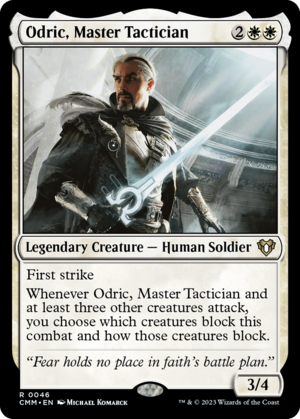
Card Details
Odric, Master Tactician #46 Legendary Creature — Human Soldier
Info
| Color: | |
| Identifies: | |
| Cost: |
|
| Rarity: | Rare |
| Converted Cost: | 4 |
| Power/Toughness: | 3/4 |
| Types: | |
| SubTypes: | |
| Languages: |
|
| Layout: | Normal |
| Rank: | |
| Saltiness: |
Abilities/Keywords
Rules
Prices
Legalities
Brawl
Paupercommander
Predh
Standardbrawl
Vintage
Gladiator
Premodern
Oathbreaker
Duel
Pauper
Modern
Alchemy
Future
Timeless
Historic
Oldschool
Penny
Commander
Legacy
Standard
Pioneer
Text
First strike (This creature deals combat damage before creatures without first strike.) Whenever Odric and at least three other creatures attack, you choose which creatures block this combat and how those creatures block.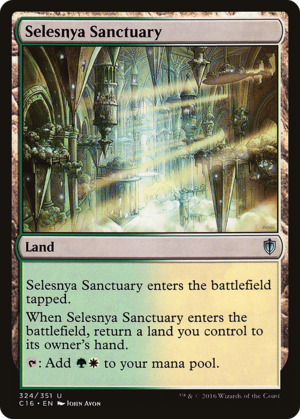
Card Details
Selesnya Sanctuary #324 Land
Info
| Color: | |
| Identifies: | |
| Cost: | |
| Rarity: | Uncommon |
| Converted Cost: | 0 |
| Power/Toughness: | / |
| Types: | |
| SubTypes: | |
| Languages: |
|
| Layout: | Normal |
| Rank: | |
| Saltiness: |
Rules
Text
This land enters tapped. When this land enters, return a land you control to its owner's hand.: Add . 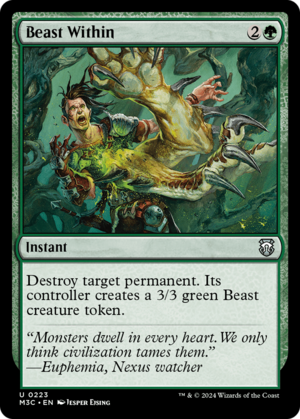
Card Details
Beast Within #223 Instant
Info
| Color: | |
| Identifies: | |
| Cost: |
|
| Rarity: | Uncommon |
| Converted Cost: | 3 |
| Power/Toughness: | / |
| Types: | |
| SubTypes: | |
| Languages: |
|
| Layout: | Normal |
| Rank: | |
| Saltiness: | |
| Tokens: |
Rules
Prices
Legalities
Brawl
Paupercommander
Predh
Standardbrawl
Vintage
Gladiator
Premodern
Oathbreaker
Duel
Pauper
Modern
Alchemy
Future
Timeless
Historic
Oldschool
Penny
Commander
Legacy
Standard
Pioneer
Text
Destroy target permanent. Its controller creates a 3/3 green Beast creature token.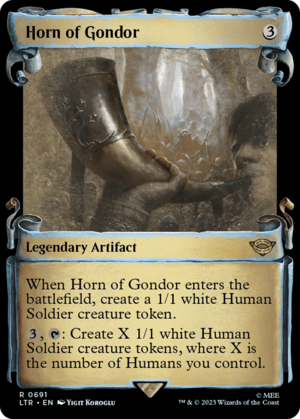
Card Details
Horn of Gondor #691 Legendary Artifact
Info
| Color: | |
| Identifies: | |
| Cost: |
|
| Rarity: | Rare |
| Converted Cost: | 3 |
| Power/Toughness: | / |
| Types: | |
| SubTypes: | |
| Languages: |
|
| Layout: | Normal |
| Rank: | |
| Saltiness: | |
| Tokens: |
Rules
Prices
Legalities
Brawl
Paupercommander
Predh
Standardbrawl
Vintage
Gladiator
Premodern
Oathbreaker
Duel
Pauper
Modern
Alchemy
Future
Timeless
Historic
Oldschool
Penny
Commander
Legacy
Standard
Pioneer
Text
When Horn of Gondor enters, create a 1/1 white Human Soldier creature token., : Create X 1/1 white Human Soldier creature tokens, where X is the number of Humans you control. 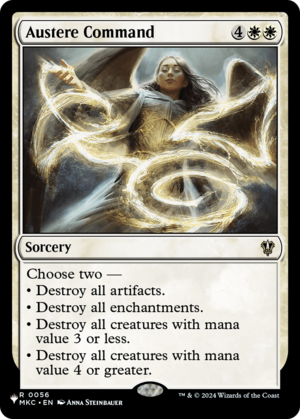
Card Details
Austere Command #MKC-56 Sorcery
Info
| Color: | |
| Identifies: | |
| Cost: |
 |
| Rarity: | Rare |
| Converted Cost: | 6 |
| Power/Toughness: | / |
| Types: | |
| SubTypes: | |
| Languages: |
|
| Layout: | Normal |
| Rank: | |
| Saltiness: |
Rules
Text
Choose two — •Destroyall artifacts. •Destroyall enchantments. •Destroyall creatures with mana value 3 or less. •Destroyall creatures with mana value 4 or greater.
Card Details
Eternal Witness #107 aka. E-Wit Creature — Human Shaman
Info
| Color: | |
| Identifies: | |
| Cost: |
|
| Rarity: | Uncommon |
| Converted Cost: | 3 |
| Power/Toughness: | 2/1 |
| Types: | |
| SubTypes: | |
| Languages: |
|
| Layout: | Normal |
| Rank: | |
| Saltiness: |
Rules
Text
When this creature enters, you may return target card from your graveyard to your hand.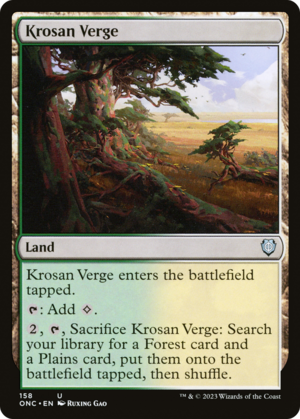
Card Details
Krosan Verge #158 Land
Info
| Color: | |
| Identifies: | |
| Cost: | |
| Rarity: | Uncommon |
| Converted Cost: | 0 |
| Power/Toughness: | / |
| Types: | |
| SubTypes: | |
| Languages: |
|
| Layout: | Normal |
| Rank: | |
| Saltiness: |
Rules
Text
This land enters tapped.: Add .
, ,Sacrificethis land: Search your library for a Forest card and a Plains card, put them onto the battlefield tapped, thenshuffle 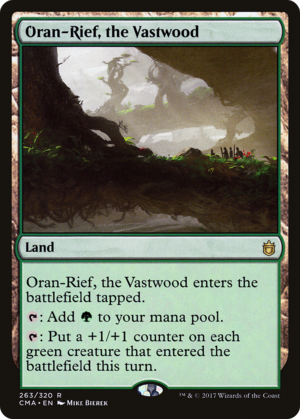
Card Details
Oran-Rief, the Vastwood #263 Land
Info
| Color: | |
| Identifies: | |
| Cost: | |
| Rarity: | Rare |
| Converted Cost: | 0 |
| Power/Toughness: | / |
| Types: | |
| SubTypes: | |
| Languages: |
|
| Layout: | Normal |
| Rank: | |
| Saltiness: |
Rules
Text
This land enters tapped.: Add .
: Put a +1/+1counteron each green creature that entered this turn. 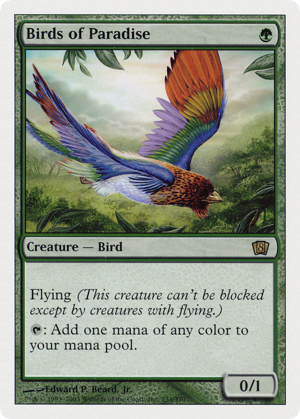
Card Details
Birds of Paradise #233 aka. Mana Birds Creature — Bird
Info
| Color: | |
| Identifies: | |
| Cost: |
|
| Rarity: | Rare |
| Converted Cost: | 1 |
| Power/Toughness: | 0/1 |
| Types: | |
| SubTypes: | |
| Languages: |
|
| Layout: | Normal |
| Rank: | |
| Saltiness: |
Abilities/Keywords
Rules
Prices
Legalities
Brawl
Paupercommander
Predh
Standardbrawl
Vintage
Gladiator
Premodern
Oathbreaker
Duel
Pauper
Modern
Alchemy
Future
Timeless
Historic
Oldschool
Penny
Commander
Legacy
Standard
Pioneer
Text
Flying: Add one mana of any color. 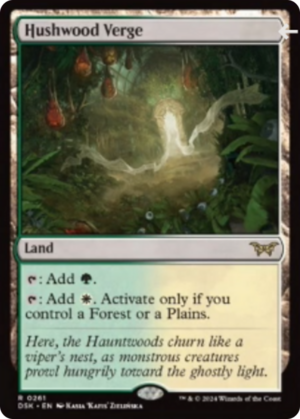
Card Details
Hushwood Verge #261 Land
Info
| Color: | |
| Identifies: | |
| Cost: | |
| Rarity: | Rare |
| Converted Cost: | 0 |
| Power/Toughness: | / |
| Types: | |
| SubTypes: | |
| Languages: |
|
| Layout: | Normal |
| Rank: | |
| Saltiness: |
Rules
Prices
Legalities
Brawl
Paupercommander
Predh
Standardbrawl
Vintage
Gladiator
Premodern
Oathbreaker
Duel
Pauper
Modern
Alchemy
Future
Timeless
Historic
Oldschool
Penny
Commander
Legacy
Standard
Pioneer
Text
: Add .
: Add . Activate only if you control a Forest or a Plains. 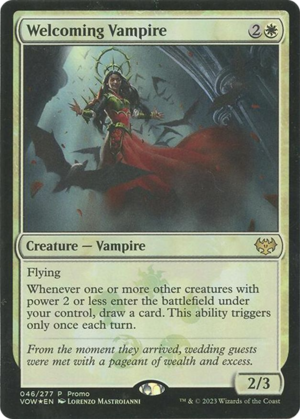
Card Details
Welcoming Vampire #46★ Creature — Vampire
Info
| Color: | |
| Identifies: | |
| Cost: |
|
| Rarity: | Rare |
| Converted Cost: | 3 |
| Power/Toughness: | 2/3 |
| Types: | |
| SubTypes: | |
| Languages: |
|
| Layout: | Normal |
| Rank: | |
| Saltiness: |
Abilities/Keywords
Rules
Text
Flying Whenever one or more other creatures you control with power 2 or less enter, draw a card. This ability triggers only once each turn.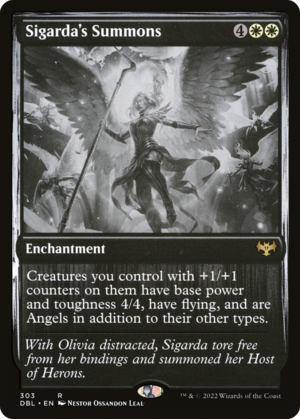
Card Details
Sigarda's Summons #303 Enchantment
Info
| Color: | |
| Identifies: | |
| Cost: |
|
| Rarity: | Rare |
| Converted Cost: | 6 |
| Power/Toughness: | / |
| Types: | |
| SubTypes: | |
| Languages: |
|
| Layout: | Normal |
| Rank: | |
| Saltiness: |
Rules
Prices
Legalities
Brawl
Paupercommander
Predh
Standardbrawl
Vintage
Gladiator
Premodern
Oathbreaker
Duel
Pauper
Modern
Alchemy
Future
Timeless
Historic
Oldschool
Penny
Commander
Legacy
Standard
Pioneer
Text
Creatures you control with +1/+1 counters on them have base power and toughness 4/4, have flying, and are Angels in addition to their other types.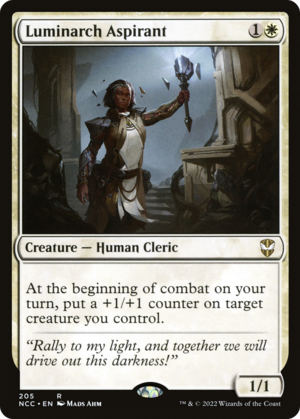
Card Details
Luminarch Aspirant #205 Creature — Human Cleric
Info
| Color: | |
| Identifies: | |
| Cost: |
|
| Rarity: | Rare |
| Converted Cost: | 2 |
| Power/Toughness: | 1/1 |
| Types: | |
| SubTypes: | |
| Languages: |
|
| Layout: | Normal |
| Rank: | |
| Saltiness: |
Rules
Text
At the beginning of combat on your turn, put a +1/+1counteron target creature you control.
Card Details
Thalia, Guardian of Thraben #137 Legendary Creature — Human Soldier
Info
| Color: | |
| Identifies: | |
| Cost: |
|
| Rarity: | Rare |
| Converted Cost: | 2 |
| Power/Toughness: | 2/1 |
| Types: | |
| SubTypes: | |
| Languages: |
|
| Layout: | Normal |
| Rank: | |
| Saltiness: |
Abilities/Keywords
Rules
Text
First strike Noncreature spells cost more to cast. 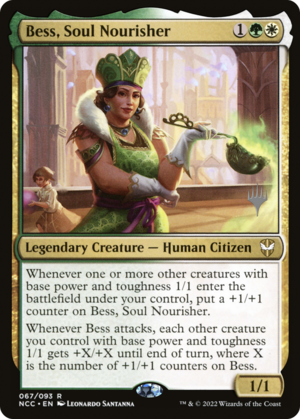
Card Details
Bess, Soul Nourisher #67p Legendary Creature — Human Citizen
Info
| Color: | |
| Identifies: | |
| Cost: |
|
| Rarity: | Rare |
| Converted Cost: | 3 |
| Power/Toughness: | 1/1 |
| Types: | |
| SubTypes: | |
| Languages: |
|
| Layout: | Normal |
| Rank: | |
| Saltiness: |
Rules
Text
Whenever one or more other creatures you control with base power and toughness 1/1 enter, put a +1/+1counteron Bess. Whenever Bess attacks, each other creature you control with base power and toughness 1/1 gets +X/+X until end of turn, where X is the number of +1/+1 counters on Bess.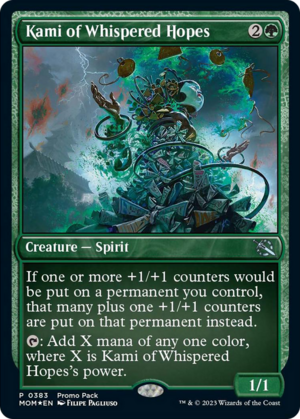
Card Details
Kami of Whispered Hopes #383 Creature — Spirit
Info
| Color: | |
| Identifies: | |
| Cost: |
|
| Rarity: | Uncommon |
| Converted Cost: | 3 |
| Power/Toughness: | 1/1 |
| Types: | |
| SubTypes: | |
| Languages: |
|
| Layout: | Normal |
| Rank: | |
| Saltiness: |
Rules
Prices
Legalities
Brawl
Paupercommander
Predh
Standardbrawl
Vintage
Gladiator
Premodern
Oathbreaker
Duel
Pauper
Modern
Alchemy
Future
Timeless
Historic
Oldschool
Penny
Commander
Legacy
Standard
Pioneer
Text
If one or more +1/+1 counters would be put on a permanent you control, that many plus one +1/+1 counters are put on that permanent instead.: Add X mana of any one color, where X is this creature's power. 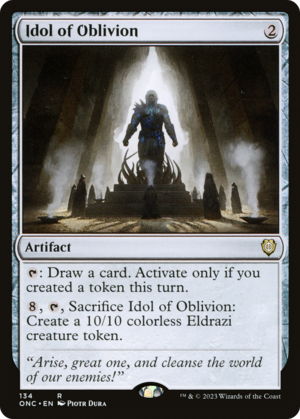
Card Details
Idol of Oblivion #134 Artifact
Info
| Color: | |
| Identifies: | |
| Cost: |
|
| Rarity: | Rare |
| Converted Cost: | 2 |
| Power/Toughness: | / |
| Types: | |
| SubTypes: | |
| Languages: |
|
| Layout: | Normal |
| Rank: | |
| Saltiness: | |
| Tokens: |
Rules
Text
: Draw a card. Activate only if you created a token this turn.
 , ,Sacrificethis artifact: Create a 10/10 colorless Eldrazi creature token.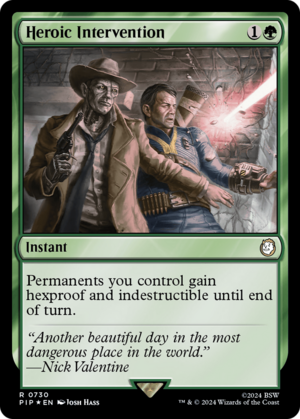
Card Details
Heroic Intervention #730 Instant
Info
| Color: | |
| Identifies: | |
| Cost: |
|
| Rarity: | Rare |
| Converted Cost: | 2 |
| Power/Toughness: | / |
| Types: | |
| SubTypes: | |
| Languages: |
|
| Layout: | Normal |
| Rank: | |
| Saltiness: |
Rules
Text
Permanents you control gain hexproof and indestructible until end of turn.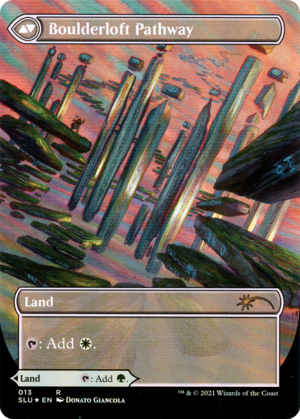
Card Details
Branchloft Pathway (Branchloft Pathway // Boulderloft Pathway) #13 Land
Info
| Color: | |
| Identifies: | |
| Cost: | |
| Rarity: | Rare |
| Converted Cost: | 0 |
| Power/Toughness: | / |
| Types: | |
| SubTypes: | |
| Languages: |
|
| Layout: | Modal Dfc |
| Rank: | |
| Saltiness: |
Rules
Text
: Add . Boulderloft Pathway (Branchloft Pathway // Boulderloft Pathway) #13 Land
Info
| Color: | |
| Identifies: | |
| Cost: | |
| Rarity: | Rare |
| Converted Cost: | 0 |
| Power/Toughness: | / |
| Types: | |
| SubTypes: | |
| Languages: |
|
| Layout: | Modal Dfc |
| Rank: | |
| Saltiness: |
Rules
Text
: Add . 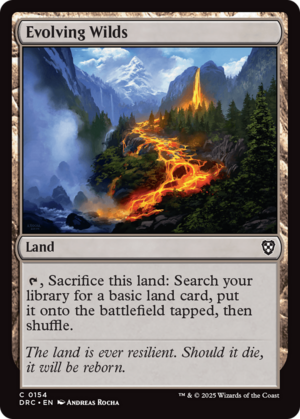
Card Details
Evolving Wilds #154 Land
Info
| Color: | |
| Identifies: | |
| Cost: | |
| Rarity: | Common |
| Converted Cost: | 0 |
| Power/Toughness: | / |
| Types: | |
| SubTypes: | |
| Languages: |
|
| Layout: | Normal |
| Rank: | |
| Saltiness: |
Rules
Text
,Sacrificethis land: Search your library for a basic land card, put it onto the battlefield tapped, thenshuffle 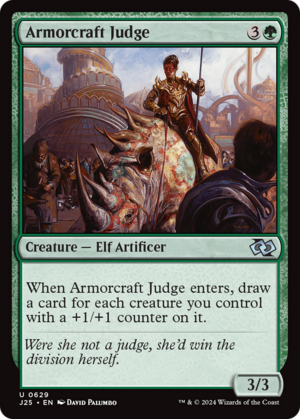
Card Details
Armorcraft Judge #629 Creature — Elf Artificer
Info
| Color: | |
| Identifies: | |
| Cost: |
|
| Rarity: | Uncommon |
| Converted Cost: | 4 |
| Power/Toughness: | 3/3 |
| Types: | |
| SubTypes: | |
| Languages: |
|
| Layout: | Normal |
| Rank: | |
| Saltiness: |
Rules
Text
When this creature enters, draw a card for each creature you control with a +1/+1counteron it.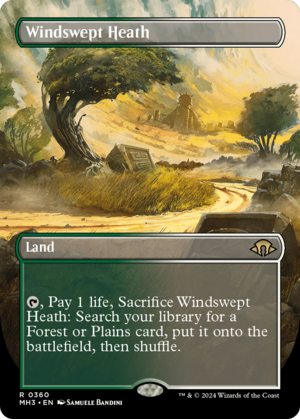
Card Details
Windswept Heath #360 Land
Info
| Color: | |
| Identifies: | |
| Cost: | |
| Rarity: | Rare |
| Converted Cost: | 0 |
| Power/Toughness: | / |
| Types: | |
| SubTypes: | |
| Languages: |
|
| Layout: | Normal |
| Rank: | |
| Saltiness: |
Rules
Prices
Legalities
Brawl
Paupercommander
Predh
Standardbrawl
Vintage
Gladiator
Premodern
Oathbreaker
Duel
Pauper
Modern
Alchemy
Future
Timeless
Historic
Oldschool
Penny
Commander
Legacy
Standard
Pioneer
Text
, Pay 1 life,Sacrificethis land: Search your library for a Forest or Plains card, put it onto the battlefield, thenshuffle 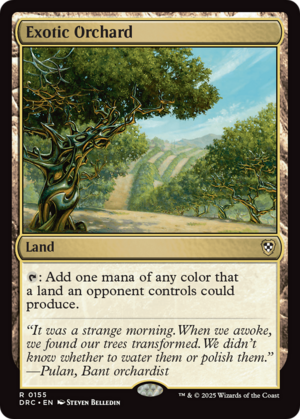
Card Details
Exotic Orchard #155 Land
Info
| Color: | |
| Identifies: | |
| Cost: | |
| Rarity: | Rare |
| Converted Cost: | 0 |
| Power/Toughness: | / |
| Types: | |
| SubTypes: | |
| Languages: |
|
| Layout: | Normal |
| Rank: | |
| Saltiness: |
Rules
Text
: Add one mana of any color that a land an opponent controls could produce. 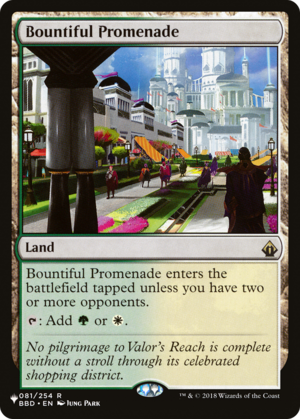
Card Details
Bountiful Promenade #BBD-81 Land
Info
| Color: | |
| Identifies: | |
| Cost: | |
| Rarity: | Rare |
| Converted Cost: | 0 |
| Power/Toughness: | / |
| Types: | |
| SubTypes: | |
| Languages: |
|
| Layout: | Normal |
| Rank: | |
| Saltiness: |
Rules
Text
This land enters tapped unless you have two or more opponents.: Add or . 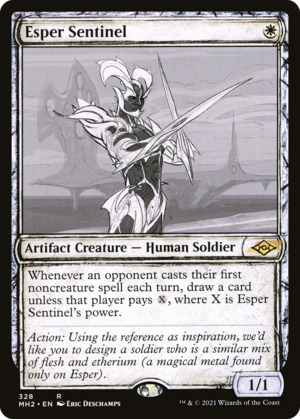
Card Details
Esper Sentinel #328 Artifact Creature — Human Soldier
Info
| Color: | |
| Identifies: | |
| Cost: |
|
| Rarity: | Rare |
| Converted Cost: | 1 |
| Power/Toughness: | 1/1 |
| Types: | |
| SubTypes: | |
| Languages: |
|
| Layout: | Normal |
| Rank: | |
| Saltiness: |
Rules
Prices
Legalities
Brawl
Paupercommander
Predh
Standardbrawl
Vintage
Gladiator
Premodern
Oathbreaker
Duel
Pauper
Modern
Alchemy
Future
Timeless
Historic
Oldschool
Penny
Commander
Legacy
Standard
Pioneer
Text
Whenever an opponent casts their first noncreature spell each turn, draw a card unless that player pays , where X is this creature's power.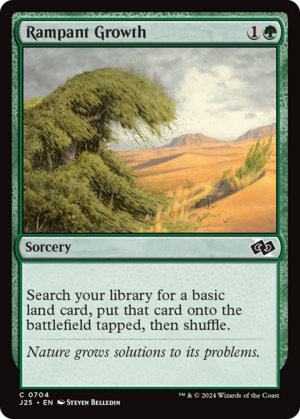
Card Details
Rampant Growth #704 Sorcery
Info
| Color: | |
| Identifies: | |
| Cost: |
|
| Rarity: | Common |
| Converted Cost: | 2 |
| Power/Toughness: | / |
| Types: | |
| SubTypes: | |
| Languages: |
|
| Layout: | Normal |
| Rank: | |
| Saltiness: |
Rules
Text
Search your library for a basic land card, put that card onto the battlefield tapped, thenshuffle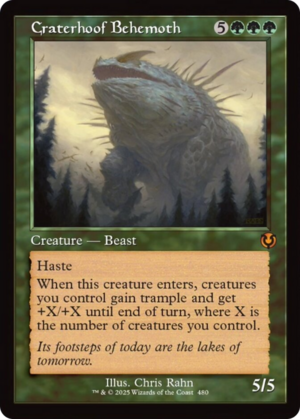
Card Details
Craterhoof Behemoth #480 Creature — Beast
Info
| Color: | |
| Identifies: | |
| Cost: |
 |
| Rarity: | Mythic |
| Converted Cost: | 8 |
| Power/Toughness: | 5/5 |
| Types: | |
| SubTypes: | |
| Languages: |
|
| Layout: | Normal |
| Rank: | |
| Saltiness: |
Abilities/Keywords
Rules
Prices
Legalities
Brawl
Paupercommander
Predh
Standardbrawl
Vintage
Gladiator
Premodern
Oathbreaker
Duel
Pauper
Modern
Alchemy
Future
Timeless
Historic
Oldschool
Penny
Commander
Legacy
Standard
Pioneer
Text
Haste When this creature enters, creatures you control gain trample and get +X/+X until end of turn, where X is the number of creatures you control.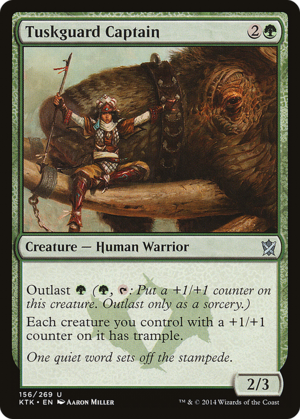
Card Details
Tuskguard Captain #156 Creature — Human Warrior
Info
| Color: | |
| Identifies: | |
| Cost: |
|
| Rarity: | Uncommon |
| Converted Cost: | 3 |
| Power/Toughness: | 2/3 |
| Types: | |
| SubTypes: | |
| Languages: |
|
| Layout: | Normal |
| Rank: | |
| Saltiness: |
Abilities/Keywords
Rules
Prices
Legalities
Brawl
Paupercommander
Predh
Standardbrawl
Vintage
Gladiator
Premodern
Oathbreaker
Duel
Pauper
Modern
Alchemy
Future
Timeless
Historic
Oldschool
Penny
Commander
Legacy
Standard
Pioneer
Text
Outlast (, : Put a +1/+1counteron this creature. Outlast only as a sorcery.)
Each creature you control with a +1/+1counteron it has trample. 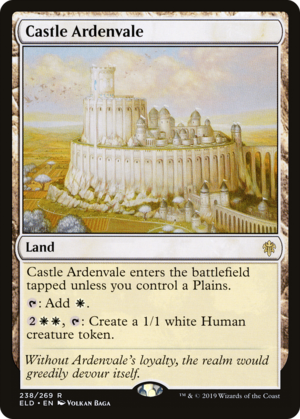
Card Details
Castle Ardenvale #238 Land
Info
| Color: | |
| Identifies: | |
| Cost: | |
| Rarity: | Rare |
| Converted Cost: | 0 |
| Power/Toughness: | / |
| Types: | |
| SubTypes: | |
| Languages: |
|
| Layout: | Normal |
| Rank: | |
| Saltiness: | |
| Tokens: |
Rules
Prices
Legalities
Brawl
Paupercommander
Predh
Standardbrawl
Vintage
Gladiator
Premodern
Oathbreaker
Duel
Pauper
Modern
Alchemy
Future
Timeless
Historic
Oldschool
Penny
Commander
Legacy
Standard
Pioneer
Text
This land enters tapped unless you control a Plains.: Add .
, : Create a 1/1 white Human creature token. 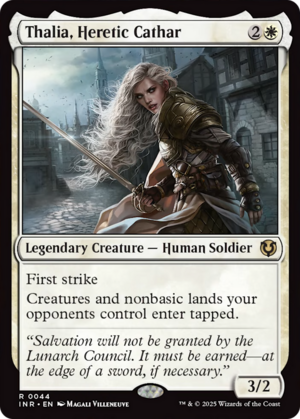
Card Details
Thalia, Heretic Cathar #44 Legendary Creature — Human Soldier
Info
| Color: | |
| Identifies: | |
| Cost: |
|
| Rarity: | Rare |
| Converted Cost: | 3 |
| Power/Toughness: | 3/2 |
| Types: | |
| SubTypes: | |
| Languages: |
|
| Layout: | Normal |
| Rank: | |
| Saltiness: |
Abilities/Keywords
Rules
Prices
Legalities
Brawl
Paupercommander
Predh
Standardbrawl
Vintage
Gladiator
Premodern
Oathbreaker
Duel
Pauper
Modern
Alchemy
Future
Timeless
Historic
Oldschool
Penny
Commander
Legacy
Standard
Pioneer
Text
First strike Creatures and nonbasic lands your opponents control enter tapped.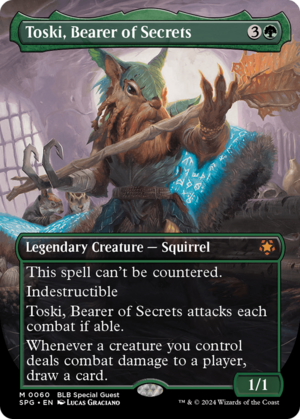
Card Details
Toski, Bearer of Secrets #60 Legendary Creature — Squirrel
Info
| Color: | |
| Identifies: | |
| Cost: |
|
| Rarity: | Mythic |
| Converted Cost: | 4 |
| Power/Toughness: | 1/1 |
| Types: | |
| SubTypes: | |
| Languages: |
|
| Layout: | Normal |
| Rank: | |
| Saltiness: |
Abilities/Keywords
Rules
Prices
Legalities
Brawl
Paupercommander
Predh
Standardbrawl
Vintage
Gladiator
Premodern
Oathbreaker
Duel
Pauper
Modern
Alchemy
Future
Timeless
Historic
Oldschool
Penny
Commander
Legacy
Standard
Pioneer
Text
This spell can't be countered. Indestructible Toski attacks each combat if able. Whenever a creature you control deals combat damage to a player, draw a card.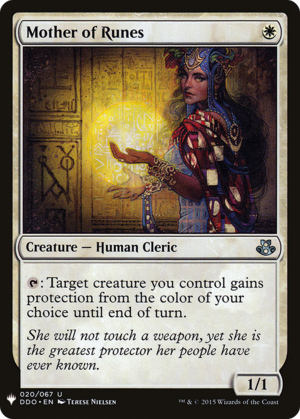
Card Details
Mother of Runes #DDO-20 aka. Mom Creature — Human Cleric
Info
| Color: | |
| Identifies: | |
| Cost: |
|
| Rarity: | Uncommon |
| Converted Cost: | 1 |
| Power/Toughness: | 1/1 |
| Types: | |
| SubTypes: | |
| Languages: |
|
| Layout: | Normal |
| Rank: | |
| Saltiness: |
Rules
Text
: Target creature you control gains protection from the color of your choice until end of turn. 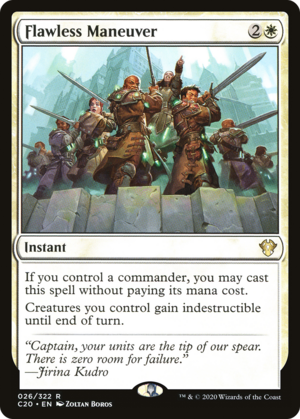
Card Details
Flawless Maneuver #26 Instant
Info
| Color: | |
| Identifies: | |
| Cost: |
|
| Rarity: | Rare |
| Converted Cost: | 3 |
| Power/Toughness: | / |
| Types: | |
| SubTypes: | |
| Languages: |
|
| Layout: | Normal |
| Rank: | |
| Saltiness: |
Rules
Text
If you control a commander, you may cast this spell without paying its mana cost. Creatures you control gain indestructible until end of turn.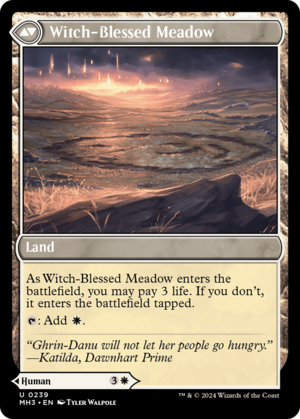
Card Details
Witch Enchanter (Witch Enchanter // Witch-Blessed Meadow) #239 Creature — Human Warlock
Info
| Color: | |
| Identifies: | |
| Cost: |
|
| Rarity: | Uncommon |
| Converted Cost: | 4 |
| Power/Toughness: | 2/2 |
| Types: | |
| SubTypes: | |
| Languages: |
|
| Layout: | Modal Dfc |
| Rank: | |
| Saltiness: |
Rules
Text
When this creature enters,destroytarget artifact or enchantment an opponent controls.Witch-Blessed Meadow (Witch Enchanter // Witch-Blessed Meadow) #239 Land
Info
| Color: | |
| Identifies: | |
| Cost: | |
| Rarity: | Uncommon |
| Converted Cost: | 0 |
| Power/Toughness: | / |
| Types: | |
| SubTypes: | |
| Languages: |
|
| Layout: | Modal Dfc |
| Rank: | |
| Saltiness: |
Rules
Prices
Legalities
Brawl
Paupercommander
Predh
Standardbrawl
Vintage
Gladiator
Premodern
Oathbreaker
Duel
Pauper
Modern
Alchemy
Future
Timeless
Historic
Oldschool
Penny
Commander
Legacy
Standard
Pioneer
Text
As this land enters, you may pay 3 life. If you don't, it enters tapped.: Add . 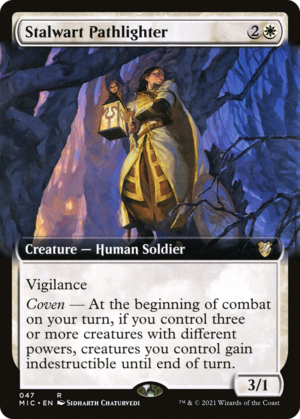
Card Details
Stalwart Pathlighter #47 Creature — Human Soldier
Info
| Color: | |
| Identifies: | |
| Cost: |
|
| Rarity: | Rare |
| Converted Cost: | 3 |
| Power/Toughness: | 3/1 |
| Types: | |
| SubTypes: | |
| Languages: |
|
| Layout: | Normal |
| Rank: | |
| Saltiness: |
Abilities/Keywords
Rules
Text
Vigilance Coven — At the beginning of combat on your turn, if you control three or more creatures with different powers, creatures you control gain indestructible until end of turn.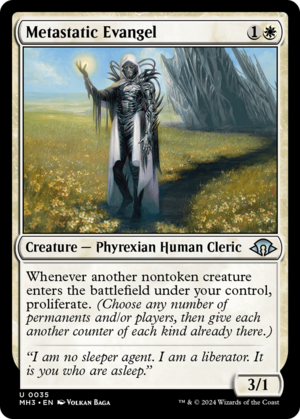
Card Details
Metastatic Evangel #35 Creature — Phyrexian Human Cleric
Info
| Color: | |
| Identifies: | |
| Cost: |
|
| Rarity: | Uncommon |
| Converted Cost: | 2 |
| Power/Toughness: | 3/1 |
| Types: | |
| SubTypes: | |
| Languages: |
|
| Layout: | Normal |
| Rank: | |
| Saltiness: |
Abilities/Keywords
Rules
Prices
Legalities
Brawl
Paupercommander
Predh
Standardbrawl
Vintage
Gladiator
Premodern
Oathbreaker
Duel
Pauper
Modern
Alchemy
Future
Timeless
Historic
Oldschool
Penny
Commander
Legacy
Standard
Pioneer
Text
Whenever another nontoken creature you control enters, proliferate. (Choose any number of permanents and/or players, then give each anothercounterof each kind already there.)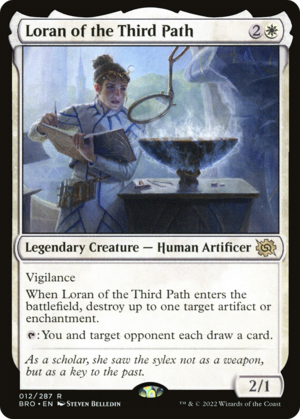
Card Details
Loran of the Third Path #12 Legendary Creature — Human Artificer
Info
| Color: | |
| Identifies: | |
| Cost: |
|
| Rarity: | Rare |
| Converted Cost: | 3 |
| Power/Toughness: | 2/1 |
| Types: | |
| SubTypes: | |
| Languages: |
|
| Layout: | Normal |
| Rank: | |
| Saltiness: |
Abilities/Keywords
Rules
Prices
Legalities
Brawl
Paupercommander
Predh
Standardbrawl
Vintage
Gladiator
Premodern
Oathbreaker
Duel
Pauper
Modern
Alchemy
Future
Timeless
Historic
Oldschool
Penny
Commander
Legacy
Standard
Pioneer
Text
Vigilance When Loran enters,destroyup to one target artifact or enchantment.: You and target opponent each draw a card. 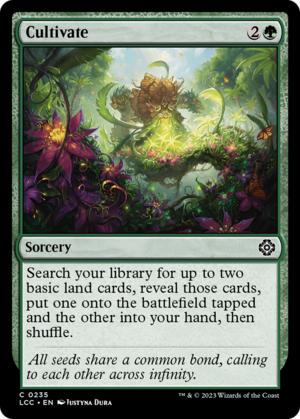
Card Details
Cultivate #235 Sorcery
Info
| Color: | |
| Identifies: | |
| Cost: |
|
| Rarity: | Common |
| Converted Cost: | 3 |
| Power/Toughness: | / |
| Types: | |
| SubTypes: | |
| Languages: |
|
| Layout: | Normal |
| Rank: | |
| Saltiness: |
Rules
Text
Search your library for up to two basic land cards, reveal those cards, put one onto the battlefield tapped and the other into your hand, thenshuffle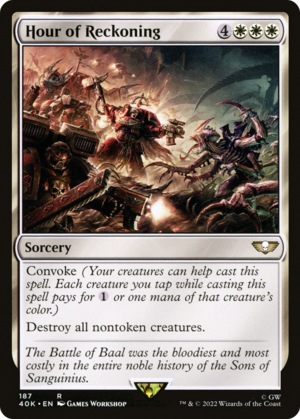
Card Details
Hour of Reckoning #187 Sorcery
Info
| Color: | |
| Identifies: | |
| Cost: |
|
| Rarity: | Rare |
| Converted Cost: | 7 |
| Power/Toughness: | / |
| Types: | |
| SubTypes: | |
| Languages: |
|
| Layout: | Normal |
| Rank: | |
| Saltiness: |
Abilities/Keywords
Rules
Prices
Legalities
Brawl
Paupercommander
Predh
Standardbrawl
Vintage
Gladiator
Premodern
Oathbreaker
Duel
Pauper
Modern
Alchemy
Future
Timeless
Historic
Oldschool
Penny
Commander
Legacy
Standard
Pioneer
Text
Convoke (Your creatures can help cast this spell. Each creature you tap while casting this spell pays for or one mana of that creature's color.)
Destroy all nontoken creatures. 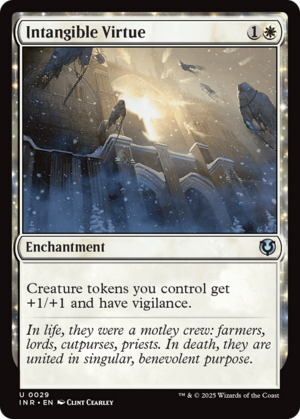
Card Details
Intangible Virtue #29 Enchantment
Info
| Color: | |
| Identifies: | |
| Cost: |
|
| Rarity: | Uncommon |
| Converted Cost: | 2 |
| Power/Toughness: | / |
| Types: | |
| SubTypes: | |
| Languages: |
|
| Layout: | Normal |
| Rank: | |
| Saltiness: |
Rules
Prices
Legalities
Brawl
Paupercommander
Predh
Standardbrawl
Vintage
Gladiator
Premodern
Oathbreaker
Duel
Pauper
Modern
Alchemy
Future
Timeless
Historic
Oldschool
Penny
Commander
Legacy
Standard
Pioneer
Text
Creature tokens you control get +1/+1 and have vigilance.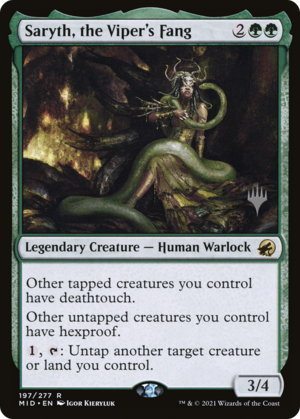
Card Details
Saryth, the Viper's Fang #197p Legendary Creature — Human Warlock
Info
| Color: | |
| Identifies: | |
| Cost: |
|
| Rarity: | Rare |
| Converted Cost: | 4 |
| Power/Toughness: | 3/4 |
| Types: | |
| SubTypes: | |
| Languages: |
|
| Layout: | Normal |
| Rank: | |
| Saltiness: |
Rules
Prices
Legalities
Brawl
Paupercommander
Predh
Standardbrawl
Vintage
Gladiator
Premodern
Oathbreaker
Duel
Pauper
Modern
Alchemy
Future
Timeless
Historic
Oldschool
Penny
Commander
Legacy
Standard
Pioneer
Text
Other tapped creatures you control have deathtouch. Other untapped creatures you control have hexproof., : Untap another target creature or land you control. 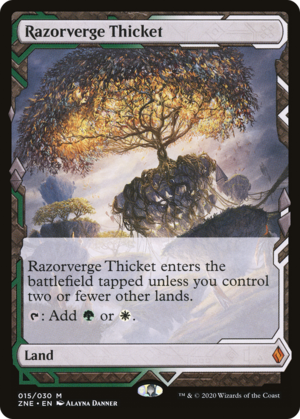
Card Details
Razorverge Thicket #15 Land
Info
| Color: | |
| Identifies: | |
| Cost: | |
| Rarity: | Mythic |
| Converted Cost: | 0 |
| Power/Toughness: | / |
| Types: | |
| SubTypes: | |
| Languages: |
|
| Layout: | Normal |
| Rank: | |
| Saltiness: |
Rules
Prices
Legalities
Brawl
Paupercommander
Predh
Standardbrawl
Vintage
Gladiator
Premodern
Oathbreaker
Duel
Pauper
Modern
Alchemy
Future
Timeless
Historic
Oldschool
Penny
Commander
Legacy
Standard
Pioneer
Text
This land enters tapped unless you control two or fewer other lands.: Add or . 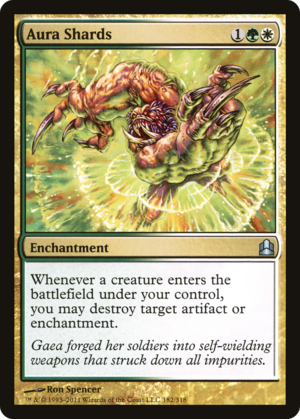
Card Details
Aura Shards #182 Enchantment
Info
| Color: | |
| Identifies: | |
| Cost: |
|
| Rarity: | Uncommon |
| Converted Cost: | 3 |
| Power/Toughness: | / |
| Types: | |
| SubTypes: | |
| Languages: |
|
| Layout: | Normal |
| Rank: | |
| Saltiness: |
Rules
Text
Whenever a creature you control enters, you maydestroytarget artifact or enchantment.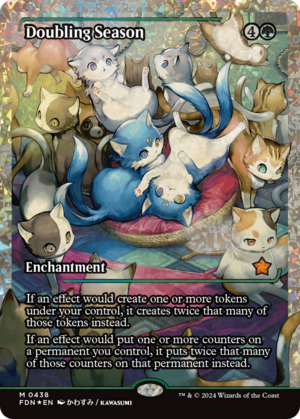
Card Details
Doubling Season #438 Enchantment
Info
| Color: | |
| Identifies: | |
| Cost: |
|
| Rarity: | Mythic |
| Converted Cost: | 5 |
| Power/Toughness: | / |
| Types: | |
| SubTypes: | |
| Languages: |
|
| Layout: | Normal |
| Rank: | |
| Saltiness: |
Rules
Prices
| Seller | Price |
|---|---|
| Tcgplayer | 663.52 USD |
| Cardmarket | 468.03 EUR |
| Cardkingdom | 1099.99 USD |
| Manapool | 1257.96 USD |
Legalities
Brawl
Paupercommander
Predh
Standardbrawl
Vintage
Gladiator
Premodern
Oathbreaker
Duel
Pauper
Modern
Alchemy
Future
Timeless
Historic
Oldschool
Penny
Commander
Legacy
Standard
Pioneer
Text
If an effect would create one or more tokens under your control, it creates twice that many of those tokens instead. If an effect would put one or more counters on a permanent you control, it puts twice that many of those counters on that permanent instead.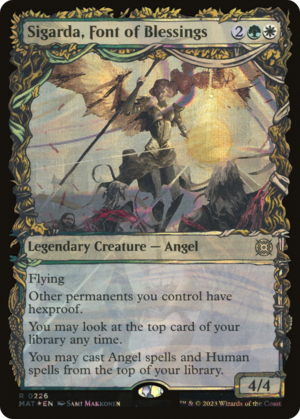
Card Details
Sigarda, Font of Blessings #226 Legendary Creature — Angel
Info
| Color: | |
| Identifies: | |
| Cost: |
|
| Rarity: | Rare |
| Converted Cost: | 4 |
| Power/Toughness: | 4/4 |
| Types: | |
| SubTypes: | |
| Languages: |
|
| Layout: | Normal |
| Rank: | |
| Saltiness: |
Abilities/Keywords
Rules
Text
Flying Other permanents you control have hexproof. You may look at the top card of your library any time. You may cast Angel spells and Human spells from the top of your library.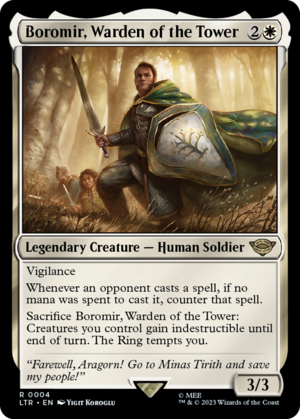
Card Details
Boromir, Warden of the Tower #4 Legendary Creature — Human Soldier
Info
| Color: | |
| Identifies: | |
| Cost: |
|
| Rarity: | Rare |
| Converted Cost: | 3 |
| Power/Toughness: | 3/3 |
| Types: | |
| SubTypes: | |
| Languages: |
|
| Layout: | Normal |
| Rank: | |
| Saltiness: | |
| Tokens: |
Abilities/Keywords
Rules
Prices
Legalities
Brawl
Paupercommander
Predh
Standardbrawl
Vintage
Gladiator
Premodern
Oathbreaker
Duel
Pauper
Modern
Alchemy
Future
Timeless
Historic
Oldschool
Penny
Commander
Legacy
Standard
Pioneer
Text
Vigilance Whenever an opponent casts a spell, if no mana was spent to cast it,counterthat spell. Sacrifice Boromir: Creatures you control gain indestructible until end of turn. The Ring tempts you.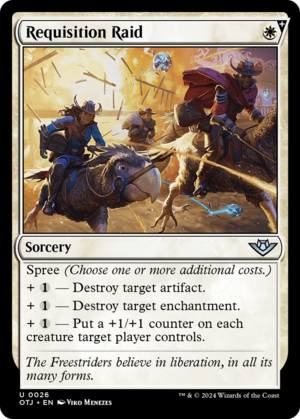
Card Details
Requisition Raid #26 Sorcery
Info
| Color: | |
| Identifies: | |
| Cost: |
|
| Rarity: | Uncommon |
| Converted Cost: | 1 |
| Power/Toughness: | / |
| Types: | |
| SubTypes: | |
| Languages: |
|
| Layout: | Normal |
| Rank: | |
| Saltiness: |
Abilities/Keywords
Rules
Prices
Legalities
Brawl
Paupercommander
Predh
Standardbrawl
Vintage
Gladiator
Premodern
Oathbreaker
Duel
Pauper
Modern
Alchemy
Future
Timeless
Historic
Oldschool
Penny
Commander
Legacy
Standard
Pioneer
Text
Spree (Choose one or more additional costs.) + —Destroytarget artifact.
+ —Destroytarget enchantment.
+ — Put a +1/+1counteron each creature target player controls. 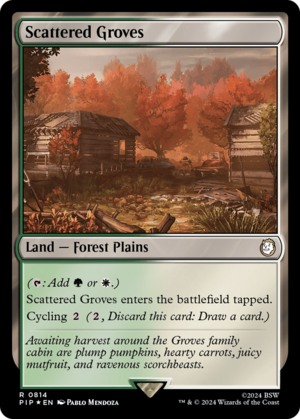
Card Details
Scattered Groves #814 Land — Forest Plains
Info
| Color: | |
| Identifies: | |
| Cost: | |
| Rarity: | Rare |
| Converted Cost: | 0 |
| Power/Toughness: | / |
| Types: | |
| SubTypes: | |
| Languages: |
|
| Layout: | Normal |
| Rank: | |
| Saltiness: |
Abilities/Keywords
Rules
Text
(: Add or .)
This land enters tapped.
Cycling (,Discardthis card: Draw a card.) 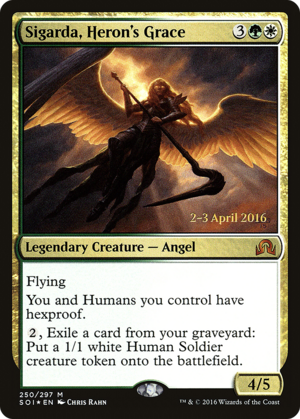
Card Details
Sigarda, Heron's Grace #250s Legendary Creature — Angel
Info
| Color: | |
| Identifies: | |
| Cost: |
|
| Rarity: | Mythic |
| Converted Cost: | 5 |
| Power/Toughness: | 4/5 |
| Types: | |
| SubTypes: | |
| Languages: |
|
| Layout: | Normal |
| Rank: | |
| Saltiness: | |
| Tokens: |
Abilities/Keywords
Rules
Text
Flying You and Humans you control have hexproof., Exile a card from your graveyard: Create a 1/1 white Human Soldier creature token.